
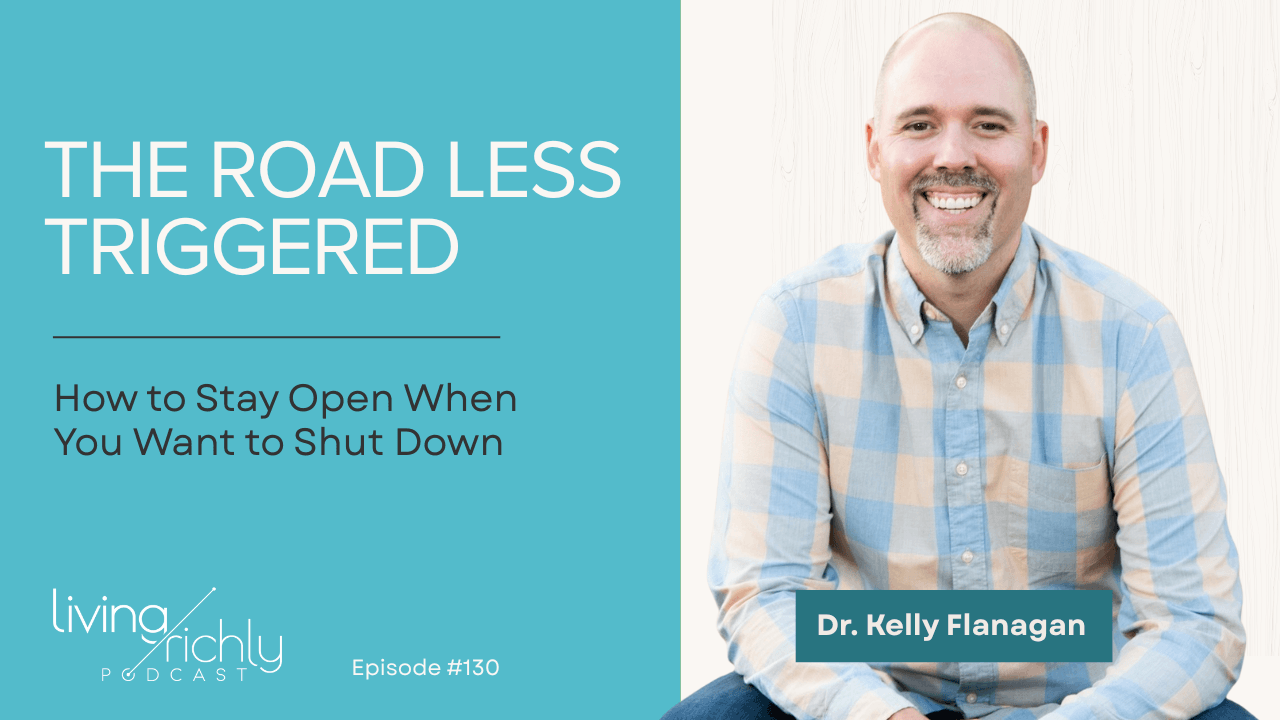


The Road Less Triggered: How to Stay Open When You Want to Shut Down takes centre stage in this episode of the Living Richly Podcast with Rob, Eric, and returning guest Dr. Kelly Flanagan. Together, they explore how emotional triggers can become pathways to healing. Drawing from his newest book, The Road Less Triggered, Kelly explains why shutting down feels protective—but ultimately blocks connection and growth.
This episode offers practical tools to stay open when every part of you wants to withdraw, including Pause + Soften, the 3‑Q Self Check, and the Stay in the Room practice. Through stories, reflection, and honest conversation, The Road Less Triggered becomes a guide for transforming reactivity into wisdom. Whether you’re navigating relationships, parenting, leadership, or your own inner world, this episode shows how courage doesn’t require calm—just intention. A deeply transformative conversation for anyone wanting to live more fully and love more bravely.
Show Notes for Episode 130
Find our Guest:
Kelly’s website
Pre-Order The Road Less Travelled
Other Books By Dr. Kelly Flanagan:
The Unhiding of Elijah Campbell
Be Inspired
Want to be inspired by daily inspirational videos? Check out https://liverichly.me/inspiration
Episode 130 Transcript
Ep130 The Road Less Triggered
Eric: [00:00:00] This is a must-have skill, the ability to keep our heart open because without it, we are literally a slave
Kelly: to our circumstances. I’m almost ready to say that almost all of our growth. It’s going to happen in the moments when we’re triggered,
Rob: when he talks about your motions be in motion and letting them flow through you and then looking at them with curiosity to say that’s interesting.
I wonder what that’s about. Your wife
Kelly: comes to you and she says you left the toilet seat up again and you feel your chest start to tighten and you feel your nervous system Activ. Your body is acting like she just tried to kill you.
Eric: Welcome to the Living Richly podcast. We’re so glad that you’ve joined us today for this really important conversation on the road. Les triggered. Rob and I today are welcoming back a fourth time guest. Amazing.
Rob: I love it.
Eric: Our dear friend, a psychologist and author, Dr. Kelly Flanagan, to talk about something really important, how to keep your [00:01:00] heart open, especially in those difficult moments where all you feel like doing is armoring up and shutting down.
You’ve ever had a moment where someone says something to you and all you wanna do is slam the door in their face? Yeah, same. So we’re gonna talk deep about that today, Kelly. So great to welcome you back to the show.
Kelly: It’s so good to be back here with you guys. Thank you for having me for a fourth time.
Eric: Yeah. You only get to come back because you keep adding so much value. So glad you’re here. And I know last time we teased out the subject of your book a little bit and to remind our. Yes, you’ve written books like Lovable. This was a book that changed my life and I think after reading your manuscript, I believe one of my notes to you was now Road Less Triggered, will be right alongside lovable for me.
You’ve also written The Hiding of Eli Elijah Campbell. You’ve written True Companions and now the Road Less Triggered. Tell us can you start by giving listeners a snapshot of the theme of the book, the subject matter, and what inspired you to write it?
Kelly: Yeah I think in a lot of ways it follows on the [00:02:00] heels of lovable, right?
In which we talked about coming to an awareness of one’s worthiness that it’s inherent in us that we don’t have to earn it or prove it. And then showing up with that worthiness and relationships to find belonging and deep connection and and me slowly discovering that I couldn’t do it.
That it would all be going really well, for a period of time. And then that thing would happen. The thing would be said something would be done and I’d get triggered and I would be flipping immediately from connection mode and into protection mode. And. I didn’t know what to do about it.
It was wreaking a decent amount of havoc in my life and my relationships, especially my marriage. But candidly into 2019 and 2020 I think my my, my getting triggered and my heart closing ended up tanking my business relationship with my best friend. And he left our partnership COVID hit.
And I I [00:03:00] was getting triggered left and right by kids homeschooling and us trying to convert mental health practices to to business businesses that were telehealth oriented. And and, culminated for me in going over the handlebars of my bike in a very triggered moment. I was trying to blow off steam toward my wife and I was triggered and I was out riding and not cautious and went over the handlebars of my bike and broke my collarbone, and I wound up the year of 2020.
That COVID year really hit a low. And just searching for what am I gonna do to get myself in shape. Frankly, I, broken collarbone that didn’t heal correctly. I was outta shape. And in the middle of thinking about my New Year’s resolutions for 2021, I came across this wonderful quote from Michael Singer’s book, the Untethered Soul, right?
Great book. Great book, right? It’s an incredible book. A lot of entrepreneurial people will recognize the book. And in the book he says, do not let anything in life be important enough that you will close your heart over it. And I thought [00:04:00] that’s what’s been happening to me over and over again.
It sets up back all the progress in my relationships. It’s like it’s a reset button, right? Relationship rupture. Now we’ve gotta repair it again. Now we gotta work back to that same place of safety and connection and closeness and and my heart’s closing, and that’s what’s happening in those moments.
So I want to keep my heart open. So I set a New Year’s resolution going into 2021. That moment to moment I’ll notice my heart closing and try to open it back up. And lo and behold. Even once I was intentional about it, I couldn’t do that either. I had to figure, I had to figure out how a person keeps their heart open as consistently as they possibly can in relationships.
And that journey led to this book.
Rob: I love that the, your writing isn’t just a bunch of theory. It is, as you just described it’s, you are, you’re actually writing out. What you’ve lived and what you’ve experienced and what you’ve struggled through.
Kelly: Yes. Yeah. Like lovable was a way of writing out the experiences [00:05:00] I’d had in me, the shifts that I knew had happened inside of me.
And now this book is essentially, writing out the experience of learning to live out my worthiness in relationships in a way that I actually show up in relationships, feeling okay safe able to stay in connection mode even when things aren’t going my way. And it’s been a journey and I can’t wait for people to read about the journey in the book.
Eric: Yeah, I love that. It sounds like you went through a series of unfortunate events and isn’t that what happens when we live life on autopilot? My mentor, Jim Harrington, who’s been on the show and has been one of the most significant influences in shaping my life talks about. Maturity, emotional maturity really being about learning to break autopilot and live life more deliberately, choosing your way forward as opposed to just falling into patterns of behavior habits that don’t serve us well.
And I know for me, when I get triggered, I had a moment this week, I had one of those days. Nothing was [00:06:00] working. And right. So I touched the coffee maker and it blows up and there’s coffee running down, all down the counter, all over onto the floor. And then I went and did something else. And insane.
Like it just was one thing after another. And I went from this zen state after my meditation time and my exercise, and I was feeling like ready to attack the day. And but before long, I was ready to attack anybody who would get in front of me, right? And so being triggered sets us off. What I love about your focus, though in openhearted is the openhearted piece.
I always focus just on the triggering and how I wanna shift my behavior, but this notion of keeping your heart open when it’s
Kelly: most difficult. I would love the, the phrase zen state, like what I’ve come to discover is that all we really mean when we say that we’re in a zen state is that our heart’s totally open.
And when we say we’re miserable, what we usually mean is my heart is closed. Love that. Because the reality is if you feel sad and your heart is open, [00:07:00] you don’t feel miserable, you just feel sad. In the meantime, you can be in front of a gorgeous sunset. Everything in your life can be going perfectly, but if your heart’s closed, you’re miserable.
And so yes, that’s the discovery is that the ebb and flow of that opening and closing of the heart determines so much about the quality of our lives. It’s so funny you mentioned everything going like literally this morning. I’ve got a really busy day. And so it’s like one of those days where I, and this is what I do, I schedule it so that every, if everything goes perfectly, I can handle it all.
And I dunno if you guys can relate to that, but, yep. So I wake up first thing the morning lights I have programmed to come on, like the sort of the strand of lights above the tv. They help me see my way around in the morning when everybody’s asleep, they’re flickering. That, they’re clearly going to need to be replaced.
Oh my gosh. Okay. I’ll deal with that later. I come down here, I throw on my expensive headphones so I can listen to some music while I’m prepping for my day. They’re bricked, right? They’re not working. I’m getting stressed. My [00:08:00] back’s starting to hurt, so I’m like, I’m gonna stand up. So I hit the button on my standup desk.
It doesn’t work. And you’re like and you can feel the heart closing, right? It’s resisting the broken lights. It’s resisting the broken headphones. It’s resisting the broken desk. And what’s starting to spin in my head is this sort of like very childlike, like the universe is out to get me,
Eric: right?
Kelly: I’m all on my own. And it’s all breaking bad on me. And I’m starting to, my heart’s starting to close to all of that, and they’re all great opportunities. Yeah, just to practice awareness that my heart’s closing and can I open up my heart to some broken lights? Can I open up my heart to some broken headphones to a broken desk?
And if you can’t open your heart to a broken desk, you’re not gonna be able to open your heart when your wife’s I really wish you’d show up a little more present as a husband and father,
Eric: Like a hundred percent. You gotta be able to handle the desk first. I, what I love about this is, it elevates the conversation.
’cause I think a lot of folks would maybe hear the subject of open-heartedness and [00:09:00] relate to it. Don’t, no doubt. I think we’ve all armored up shut down when we would’ve preferred to do something different. But I think we often treat it like a nice to have as opposed to this is a must have skill, the ability to keep our heart open because without it, we are literally a slave to our circumstances.
The outside world determines our inside state as opposed to us setting. Taking control of that inner state and learning the practices and the skills to live in that. And when we say zen state, we’re not talking about nirvana here or utopia, but we’re talking about grounded and settled within ourselves and.
More, more clear about the way forward. So this becomes like a, it’s like a non-negotiable, not just like survival skill, but thriving skill. If we wanna live richly, man, this shit is right at the core of it.
Kelly: It real, I love the way you described that. It’s a must have skill. It’s foundational.
And the irony is that when your heart is [00:10:00] closing, what you’re doing is, it’s a, it’s an impulse to take control of the situation, ironically, but it’s incredibly disempowering as you point out actually. Because as soon as your heart closes, the circumstances are now determining your inner. Condition.
You lose access to all of the best stuff that you have. All of your wisdom, right? All of your intuition. When your heart closes, you’re now just in protection mode. You’re not even connected to yourself. And you’re losing awareness of the fact that you have a choice about how to show up to this moment.
The moment is deciding how you show up. And so it’s a very disempowering place to be, even though your impulse in the moment is to take some control of it. And so to actually be in control. We actually open up our hearts and we. Begin to participate with what is, rather than demanding that what is changes before we interact with it.
And so the capacity to participate and to dance with it rather than dual with it, I think is like you said, it’s an essential skill that we have to have as we move through.
Rob: I love [00:11:00] that you referenced that, how people will often think of that closed mind. It is a, for many, it’s a myth, but they think it’s a defensive mechanism.
It’s this is how I protect myself in this moment when everything’s going bad. If I just shut down and don’t feel, then I’ll be okay. I’ll be in control and I’ll manage when it’s the opposite is actually the truth.
Kelly: Yeah. The impulse with the closed heart is, I don’t wanna feel the hurt of what’s happening, right?
But, and that’s, and to some extent there’s some truth in that. A closed heart will prevent you from feeling the hurt of what’s happening. It will also prevent you from participating with what’s happening in a productive way. Influencing it. One of the, one of the important distinctions and this goes all the way back to Eastern, philosophies and all the way into modern sort of wisdom, is that there’s a difference between pain and suffering.
Pain is the inevitable sort of reality of life. We’re gonna have things that happen that hurt. Suffering is the unnecessary pain we create when we resist [00:12:00] that first. Ouch. And so I think of a closed heart as the unnecessary suffering we create when things are hurting and not going the way that we want them to.
And if we can eliminate that, then we’ve got maybe 20% of our pain left over. We can handle that. Gonna learn how to handle that.
Eric: The Buddhists refer to that as the the second arrow, right? The first arrow. The first arrow is what life sends our way. We can’t control and it hits us and we feel that pain.
The second arrow is what we then start throwing our own way because of how we’re navigating that first wound. I’d love for us to dive into the courage that it actually takes to keep your heart open. Because to your point, I think there are moments, think of severe drama I or trauma. I would love to hear your thoughts on this.
There, there are times the mind does protect the individual by shutting some things down because it may be too overwhelming. That’s, we’re not talking about that today. I think we’re focusing more just on the day-to-day stuff that, that unfolds. But that it still requires courage to stay open [00:13:00] and.
I think this is more significant for men in all of my conversations with men and the guys that are part of the foundry and our clients in our coaching business. And I’m sure you’ve seen this open-heartedness is often viewed as weakness it’s seen as a vulnerability or a flaw.
Can you speak to that?
Kelly: I’m gonna be speaking to that this afternoon and and next week in the Florida Keys at a speaking event, because this is something I discovered early on in starting to share the, what I consider to be the good news of open-heartedness with people. I I realized I had a huge blind spot that when I told people about open-heartedness, what they heard was boundarylessness.
That if I have an open heart, I can’t have any boundaries in two directions. Really like doing oriented driven overachievers. When they heard about open-heartedness, they heard I no boundaries about what comes outta me. Am I gonna have to share everything? Am I gonna have to tell everybody everything?
More being oriented sort of space [00:14:00] holders, what they would hear is, wait, am I just gonna have to allow people to do whatever they want to me? So one of the first things that is important to address with this is that open-heartedness doesn’t make our boundaries weaker. It makes our boundaries wiser.
Oh, I like that. That you can set boundaries with a closed heart and they will almost guarantee. That you create battles with your boundaries. If you set your boundaries with a closed heart, if you set your boundaries with an open heart, you’re actually inviting collaboration rather than queuing confrontation.
And so it’s a wiser way to set boundaries. It invites people to participate in you getting what you want. And so these two things are very distinct, even though at first when we hear open-heartedness, we hear weakness. But it’s not the
Eric: case.
Kelly: A
Eric: hundred percent. And I think for a lot of us, I’ve been getting really present in my own life to the way that I often respond to challenges or life not going my way.
That what I thought was boundaries is really control. Covering up [00:15:00] fear dressed in a nicer suit. It appear, right? It’s it, there’s a performance thing that kicks in. There’s a I go from being tender and more open and whatever to just like, and I just lean in and I am gonna get shit done now.
And it’s almost, I, it’s almost like my drug of choice to manage my anxiety through it. But that drug is toxic over time. Like it’s really bad fuel to run on.
Kelly: And I, and to come back to what you said about the amount of courage it takes then, right? It open-heartedness isn’t weakness, but it still takes courage because in the moment in which your heart’s closing, almost always, your nervous system is also activating, right?
You have a nervous system that’s designed to protect you from danger. And your nervous system is activating, saying you, there’s an existential threat here that you are about to face. And it takes a tremendous amount of courage to root yourself in the present. Keep in mind, our nervous systems, they [00:16:00] evolved for one purpose.
If we are, if our life is being mortally threatened. Yeah. Okay. Fight or flight and right. And so when your nervous system is activating, it takes a tremendous amount of courage to look around and go, is my life being mortally threatened in this moment? And if not, let’s start to open up to what’s happening here.
Let’s start to calm the nervous system. Let’s try to get reconnected with a sense of our basic sense of safety in this moment. And it’s pretty remarkable when you start to think about it this way, every time your nervous system activates. If you’re not being mortally threatened, you’re not in the present.
Okay, so your wife comes to you and she says you left the toilet seat up again and you feel your chest start to tighten and you feel your nervous system activate. Your body is acting like she just tried to kill you. And she might like,
Rob: I think that’s a valid reaction.
Kelly: Right?
It certainly feels that way. And she certainly might threaten it but the courage, when your body is telling you’re about to be annihilated. To actually stay [00:17:00] present and openhearted. Yeah. That is big. That’s a big deal. And so you absolutely, it, it takes tremendous courage.
Rob: So what does that look like?
Eric, you shared the story about just this week the coffee maker, of course, Kelly, you were just talking about even how your mourning. Started today. What a great opportunity to close up. So in a real practical way, what is being open-minded or what is open-heartedness, open-minded, open-heartedness mean or look like when you are in these kind of moments that everything seems to be going wrong and you want to armor up, you want to close up?
Kelly: Yeah. So in, in the road, less triggered, what I wanted to do was not just inspire people. To open-heartedness. But I wanted to equip people to open-heartedness. I wanted to lay out a very clear process for what to do in the moments where you’re most triggered. I, in the book, I call it the peaceful pivot process it’s got nine steps to it, three parts, and the three parts are get calm.[00:18:00]
Get free and get connected. Okay. Yeah. Yeah. And they’re specifically laid out in that order because usually when we’re triggered, our first impulse is to reestablish a sense of connection. With this person, right? So that I can calm down inside. And it has worked zero times in the history, if you may. If you’re dysregulated, your heart’s closed and you’re triggered you’re in protection mode.
So it is literally impossible for you to cultivate connection from protection mode. And so we start the peaceful pivot process with these three steps of getting calm, taking responsibility for that nervous system. Number one, giving yourself a little bit of an advantage by using your body to notice when you’re starting to get triggered and your heart’s starting to close.
Disrupting your defensiveness is by learning to watch it instead of wielding it, and then going right to the source of your dysregulation and learning how to calm your body. We had this summer during a very hot week our furnace the control board on our furnace went on the fritz.
And our air [00:19:00] conditioning wasn’t working. It was really hot in the house, what most of us do when we’re triggered the equivalent is they, we think, how can I cool it down here in the house by changing the temperature outside? We think, how can I change what my wife says or what my friend thinks about me?
Or who hung out with who so that I can make it a little cooler in here. And and so in this first part of the process, we talk about going directly to the source of the dysregulation, your inner control board, getting it fixed, getting yourself calm, so that you can then show up to the world for and to your people from a more regulated place.
Yeah,
Eric: I absolutely love that. And if I learned anything about what blew me away about lovable, and we’ve talked about this on previous times that you’ve been here, was how you presented sequence really matters, right? How you presented, worthiness first, right? Worthiness first, because without that, you chase your worth.
Then in your relationships, you chase it in your work and you’re expecting others to do the work you need to do for yourself, right? That. And [00:20:00] so in this, it’s the same with the road less triggered with your process sequence really matters. Going inside first to regulate and figure out what’s going on and not look for those external things to change, is absolutely brilliant.
And that’s why, again, I come back to why it takes why open-heartedness is. Anything but weakness or anything but soft it is, again it’s, it requires courage. It requires presence. And this is where we practice becoming the best version of ourselves and experiencing, I think greater, I don’t know, greater peace of mind more often.
Kelly: Yes. Oh, first of all, thank you. I feel really seen I think you just saw something that I have not seen before, which is how much the concept that sequence matters is central to what I do and talk about and how I help people. And I think that’s exactly right on and to, so one of, one of the.
Unspoken symbols in our house. [00:21:00] Now that someone is doing the brave and courageous thing to take ownership of their reaction is, say, when I’m feeling myself triggered and my heart starts to close, and it, for me, it’s always in the chest area that I feel it first and foremost, same and me putting my hand over my chest and closing my eyes.
Taking a deep breath and starting to work on getting regulated. Like we hear openhearted and I think we, it has a feminine sort of connotation to it. There is nothing more masculine than owning your response in that way. Getting into your body and saying, I am going to. Empower myself in this moment to get myself regulated before I expect anything from anybody else.
And I think that is a powerful example we set for our people in terms of leadership of our people, is that we’re gonna take ownership for showing up as a safe space and a regulated space before we expect anything else from anybody else.
Eric: As you were describing that, I had an [00:22:00] image of the martial artist about to square off, your typical martial arts movie where the hero is about to square off with 20 opponents and they’re all frantic, ready to attack, and he just zeroes in and goes into this state of focus.
So again this notion of the warrior poet, this is. This is as masculine as it gets. This is tapping into your inner strength, taking responsibility for what’s happening inside your inner world, and understanding that panic and control and fear and shutting down that all those things actually.
Keep you from all of your best resources. It’s like all of a sudden you’re cut off from your values, your intentions, your goals and they’re still there, but you really have a hard time accessing them. What do we say when we get anxious, we get stupid?
Kelly: That’s right. We literally do, we start our lizard brain takes over.
Yeah. And Liz Lizard’s, IQs are pretty low, right? Yeah. And so that’s normal yeah. You get, you will get stupid when you’re triggered [00:23:00] because you’re acting according to your most ancient. Capabilities. And
Rob: I love how you described that, Kelly, and even that hand on your chest again, f from for men who want that control, the masculine, there’s something powerful when you recognize you actually have that control over your own system.
And I just think recently I was in a therapy session with Dr. Sherry, is who I talked to. And as we’re talking, what happens for me is. I know when I’m starting to get anxious as because of my breathing, my, I start to get very shallow breathing and she sees it. And so she, as we’re talking, she said, Hey, let’s stop for a second.
And then she just took me through a, we just did the long breath. And I remember at first, my first reaction when she said, let’s stop. We’re gonna breathe for a second. I was like, I don’t wanna breathe. I wanna solve this. I wanna fix. Like I was almost, but she, and just that control the ability to control everything about your nervous system with a breath.
Yeah. And now you can enter [00:24:00] whatever that situation is in the right, with the right mindset.
Kelly: One of the earliest warning signs for me that I am my heart is closing is just. Just a really subtle sense of urgency that starts to kick in. Like a wanting to move faster. Talk about this faster, get in there and and just a speeding up.
And I was actually just last weekend, I was making the first pot of chili of the winter and I got started late on it, so I was in a hurry. And so I’m trying to, I’m using a manual can open, I’m trying to get the crushed tomatoes open as fast as I can, and it’s just spinning, right? And I’m like the can opener’s broken and my wife’s turn it more slowly.
And I start to turn it slowly, which gives, of course, the little tins and opportunity to grab and I get the can open. Way faster. Turning it slowly than I would’ve gotten it open if I kept trying to turn it quickly. And I think this first part of the peaceful pivot process is like that. Everything in us says [00:25:00] speed up to try to solve the situation.
And we actually slow down and get regulated and discover that we open the can to open the heart much more quickly. If we do that first.
Rob: What’s the military? Slowest. Steady, slowest. Steady and steady
Eric: is fast, right? There it is. That’s it
Kelly: right
Eric: there. Yeah, I love that. We often talk to, I often talk to my leaders about learning to slow down to go fast because we especially if you’re entrepreneurial, if you’re a leader, if you’ve got lots riding on your shoulders in terms of responsibility and I think leaders really feel that I think every human being can relate to what we’re talking about.
I just think leaders carry that. They carry all the life stuff that everybody else carries. And then on top of that layer on all the leadership stuff, right? And like you, my tendency, I know when I am. Getting off center, I also feel rushed. I feel pressured, and I feel behind all of a sudden and behind and not enough.
And so I’ve learned to recognize when I’m feeling behind. And what’s interesting [00:26:00] is I’m in charge of my own day to day. So who am I behind on? Other than maybe my unrealistic expectations, right? Like it’s, I am the leader for Christ’s sake. Like I, what am I behind on? But this notion of learning to slow down so that you can then get clear, get focused, identify what’s going on, and then truly go fast because you’re moving on the right thing, not just frantic activity, which is my pattern.
Kelly: I wanna double click on something you just said there ’cause it resonates so much. So I know it’s gonna resonate with. People listening, I’m at a men’s conference. We walk into the conference room, there’s piles of rocks all around the room, and halfway through the session they say, go find a pile of rocks.
You got 10 minutes. They just taught us about the the ancient Scottish tradition of Karens, which is where you pile rocks. Sometimes for practical reasons, sometimes just for spiritual ones. So go pile your rock. Find a pile and create your pile. Got 10 minutes. I’m fi I’m five minutes into my 10 minutes and I realize that I’m stressed and anxious and frustrated, and I’m like, what am I?[00:27:00]
And I realized it was because five minutes ago I set the goal that I was gonna use all of my rocks in a single pile and build the tallest pile in the room. I am stressed by a goal I fabricated five minutes ago. And in, in the same moment that I’m realizing that I look at over at one of my best buddies who’s a few piles down, and what he did was he took each rock and he set them separately on the floor so none of them were touching.
And he was sitting there breathing and meditating.
And I’m like, okay. And I that, that actually is. A constant awareness I’m trying to bring into every day at this point is what goals are you fabricating that. You feel like if you fail those goals, today is a failure and let’s just throw those out the door right now. Let’s open up to what it is.
Let’s live what it is and where the day ends up is where it ends up, but it’s gonna end at five so you can get to your family and enjoy yourself.
Rob: I’m reading Mo God’s book right now called Solve for Happy and he was the [00:28:00] somebody big at Google and in solve for Happy, he basically created he engineer guy.
So he creates an equation for happiness and it’s, the equation is when reality is less than. Expectations less than or equal to expectations, you’ll be happy. And when reality is greater than. So in other words, when expectations are less than your reality, you’ll be unhappy. And setting that and it’s this notion of, again, the expectations we set for ourselves often create.
They’re not realistic. And so that’s where all of this frustration and closed heartedness happens is because we’re now trying to chase after unmet expectations.
Eric: Absolutely. Dr. Sherry is notorious for with me at least. I may sometimes, once in a while, set unrealistic expectations. I know like everybody, like I know you.
You heard it first. I’ve here, I’ve known you 35 years here on the Living Risky Podcast. It’s a big reveal. I sometimes set expectations that are outta whack and [00:29:00] we’ll be talking and she’ll just stop and look at me. And in her southern draw I’ll say. Now, Eric, those expectations don’t sound like they’re in land with reality.
I over get the southern draw, but you get the point, she doesn’t sound like that at all. She doesn’t sound like that at all. I’d like us to shift into the hidden payoff. Of getting triggered. ’cause we often think that as a real negative thing and again, you’ve helped me rethink this, but so we’re gonna go there next, but what I do wanna say is I was talking to Steve before the show.
I’ve had a conversation with Kate about this as well. So Kelly back in 2021, late early 2022 is when I read, first Read lovable. And it came at a time in my life where I fucking really needed it. It changed my life and I’ve told you that before when you reached out to me not long ago. To be one of the first to read your transcript of your new book, which I absolutely love and will be, recommending everyone I know read it.
It’s gonna be right there. It says Get [00:30:00] lovable and these, like these two books and they’ll change your life. It was just such a beautiful gift from the universe for a few reasons. One, because here you were this guy from another part of the world who wrote this powerful book. Now we’re connected as friends.
I consider you a brother. To be asked into that process and to be part of that just felt like surreal. So I just wanna say thank you for that gift of being early in the process of being able to read your book. It was a real gift to me, so thank you so much for that.
Kelly: You’re welcome.
And your endorsement was a huge gift to me, so thank you. Yeah.
Eric: Look, I think it’s gonna, my endorsement’s gonna be on the jacket of the book.
Kelly: It’s actually on the back cover of the book. Yeah, I think I love it. A snippet of three different endorsements made the back cover as far as I know at this point, you’re one of them.
Eric: Yeah. That’s awesome. That’s awesome. So let’s talk though about this myth about ’cause I think to a degree I used to think this and I think there’s moments I still do where in my healing journey, I’d I’ll reach a point where I don’t get triggered. I think we’ve got these. It these images of the [00:31:00] Dalai Lama and Kdi and Jesus.
But even they got triggered and like all the time. So can we talk about the gift of being triggered and can we bust that myth wide open?
Kelly: Oh yeah. Dalai Lama is a great example. ’cause one of my favorite stories was he was being interviewed on a panel on Krista Tippets on being podcast, I think.
And, he was. Very peaceful in how he was showing up. And she said to him, she said, I just wish I could follow you around for a day and soak up your peace. And he laughed as he does. And he said if you follow me around for a whole day, you’re also gonna have to soak up my anger and my fear and my sadness.
He’s, he knows. He knows that we don’t the finish line isn’t an absence of these things. The, there isn’t really a finish line except to the extent to which you’ve accepted that they’re a part of the human experience and you know how to keep your heart open in the midst of all of them.
And and so for me, in my own personal growth journey as well as the coaching that I do with my [00:32:00] clients I’m almost ready to say. That almost all of our growth is going to happen in the moments when we’re triggered when we’re in our zen moments, right? We’re enjoying the fruits of our growth.
But when that heart starts to close, now it’s game on now. Now we’re growing again. And I shared this metaphor in one of our previous conversations, I think a couple ago that the moment we’re triggered is like an X on a treasure map. Okay. And. Ironically, we stumble across this X on the treasure map, like an X on the ground, and we try to erase the X or we’re like, we’re never coming back to this X again.
And it’s like there’s a shovel right there next to the X. And if you started digging into this moment, there’s treasure buried underneath that. And one of the things I talk about in the roadless triggered is this idea that curiosity is the shovel. When you start to get triggered, if you can bring a spirit of curiosity to that moment going, [00:33:00] huh?
I wonder what’s going on underneath this. I wonder why I feel existentially threatened in this moment. I wonder how I’m gonna grow and heal through this moment. I wonder how my relationships are going to be enriched and deepened by that healing. All of a sudden, to me, that’s the turning point that, and we’re talking about step eight outta nine in the process.
When that’s now how you think about your triggered moments. It’s a game changer. It’s a game changer because now when they happen, you’re not like, oh no, you’re like, oh yeah, let’s go. Love
Rob: that. It reminds me of an untethered soul when he talks about your emotions be in motion and letting them flow through you and then looking at them with curiosity to say that’s interesting.
I wonder what that’s about. That really that’s what came to mind as you were sharing that, Kelly, the how do you know when. Those trigger moments are opportunities to figure things out versus an opportunity to set boundaries and to set up protection. Like you, the curiosity.
What are some things that people could be [00:34:00] asking other than just, that’s interesting, but how do you get below the surface? How do you start digging?
Kelly: That’s good. You can always assume that when you’re triggered and your heart’s closing, you are blocking some sort of emotional experience that you’re needing.
I, I love the reference to emotions, right? They’re meant to be in motion. They’re meant to flow. When we close our heart, we’re not just keeping new hurt from getting in or preventing old hurt from flowing out. And one of them are fascinating fruits of this process is really this discovery that you don’t understand your way into feeling.
You feel your way into understanding. So at this point when my heart closes, one of my first questions is, what’s the sadness? I’m trying not to feel right now. Okay? And if I let some of that sadness flow, what happens every single time is I understand a little bit more about what I want in my life.
And now I’m equipped to more wisely go out and ask for what I want, which is the first step in setting a healthy, open-hearted boundary. You don’t have to jump in with demands, [00:35:00] right? You go, Hey, I’m more aware of, I want this in my life. And this in our relationship. And it turns out when you show up open-heartedly asking for what you want, people tend to want.
Participate with you. And if they don’t then you’ve got some decisions to make, but you’ll just make those decisions openheartedly. And so I think that’s an Im important piece of it, is letting the feelings we’re blocking when our heart is closing, actually teach us how we’re wanting to show up in our life and what we’re wanting from it.
I love that. And again,
Eric: back to the ex, Mark Marks the spot and wanting to avoid it. I think the image I had there was, we need to channel our Jack Sparrow and that’s right. Alright. Does that include the rum? There’ll be some booty there. Yeah, exactly. There’s a be some booty there under that rug or right under that said in order to dig, can you share a story of someone that you know, obviously keeping it, but an example perhaps for our listeners that got freed because they got triggered. Whether that’s in your own life or a client that you’ve worked with because I think putting it into a story format or an example is [00:36:00] useful for our listeners.
Kelly: It’s such a good question. I’m gonna tease the book a little bit to begin with. Yeah. And say that one of the things that I wanted to do in the book is make it really practical and actionable. Okay. One of the ways that I wanted to do that was to offer an actual concrete exercise at each with, for each of the nine steps that you could actually practice in order to help you with that step.
But I’m like, like the whole exercise, like cutouts in a book are so dry and boring and I just skip over them. So I’m like, how could I illustrate this in a really engaging way? So what I do is I created a fictional. Couple. That’s an amalgam of all the couples I’ve worked with and myself of course.
And and I take this couple through the peaceful pivot process, nine exercises at a time, basically. And so you get a window into the transformation that starts to happen for a couple in those situations or for each individual in those situations. So I’m looking forward to people enjoying getting to know.
Henry and Sarah. Yeah, they’re two really cool people. And [00:37:00] they’re really close hearted and by the end they’re not. Yeah. So that’s a plug.
All: That’s a good
Rob: one. And it’s a good plugin. Let me add this while you’re thinking about the response for Eric, because unhinging of Elijah, and I know that Elijah in that case was also probably a kind of a mix of a whole bunch of different individuals.
The end of that book, I think is the first time I’ve done movies and that but in reading a book, that’s the first time that I broke down and wept. I reading the last chapter of that book as it all comes together and that the un hiding truly happens, and part of me was the gig. Kelly, that’s not even a real person and I’m crying for them.
So you do it really well. So it’s a great plug for the book because I think people will become, to come to embrace this couple.
Eric: Yeah I thoroughly enjoyed that storytelling aspect of walking through this journey with this couple and again, a representation I think that I certainly could relate to so much of the story that was un that’s unfolding.
So you did a beautiful job there.
Kelly: Yeah. And I think, the [00:38:00] way to answer your question most easily, and this has always been one of my principles, is that, if I can’t reference it in my own story, then I probably don’t have any business talking about it. So I’ll give you an example of a before and after snapshot before and then after being something that happened this week in my own marriage.
The before Snapshot is. In a week where my wife, who is she is, she’s a free spirit. Our friends joke that she’s a force of nature. I, my nickname for her since I met her is Spark blood. ’cause she fires up so fast. She’s Portuguese, she’s an Enneagram mate with a seven wing. She lives life big, right?
And so she’s got tons of things she’s doing and loves to do. And, and so in a week like we had last week, it, for probably 15 to 20 years in our relationship, what would happen is she would be serving on the school board and she would be packing buddy bags for school lunches and she’d be doing all these things and going to work and all that.
And I would hold down the fort and I would try to be a great husband supporting him this way and that way. And [00:39:00] then she’d get home at the end of the week. She’d say something like, I feel really alone in our relationship. And I would lose my ever loving mind. I, dude,
Eric: I, you said that and I felt it.
Yeah.
Kelly: I, and once, and I tell this story in True Companion, something like that happened. And what I did was I went and I created a Word document of everything I’d done for her and the family all week long. Oh my God. Formatted it with different fonts and bullet points. And we got into bed that night and I was like, Hey, I’ve been thinking about what you said, and.
I handed it to her. Oh, it did not go well. No, eh.
Eric: Oh, surprise. I thought that was a brilliant strategy. I’m surprised it didn didn’t work. Yeah,
Kelly: I know who could see that not working out. So that’s the before shot. The a, the after shot is we just had a week like that. And because [00:40:00] we’ve quit trying to.
Sort of fix our wounds and eliminate our patterns and a abolish our triggers. We’ve come to know them well enough that we can show up to them differently. So first of all what we know is that she has an abandonment wound. She’s the barometer in our relationship for the level of closeness and distance in the relationship.
She’s also an Enneagram eight, so when she’s feeling distant, she blames me. And that’s just how she works. I have an inadequacy when I have a shame wound, right? And what that means is I’m trying to do, try to love my people perfectly and do good enough for them, and that’s how I’m trying to earn their love, right?
So I look at the, I look at our calendar this week. And I’m like, oh, she’s got something every single night. I know what’s gonna happen on Friday night. She’s gonna tell me she feels disconnected and alone and I’m and she’s gonna suggest I’m not doing enough as a husband and I’m gonna get triggered.
And and so it [00:41:00] happened. It happened and I felt my chest start to tighten up. ’cause you don’t quit getting triggered, you just learn that it’s coming and. But then the, my heart immediately opened with this phrase, she’s feeling lonely and I am too. I miss her. And my response was simply, I missed you so much this week.
What do you wanna do tonight? Right now again, she’s Enneagram eight. She looks at me like side eye, even though that’s a suspicious response. You’re supposed to like print, you’re supposed to print out your list of things you’ve done this week, and but I give her credit ’cause she’s doing her work too.
And and she opened her heart to me and we had a lovely night. So to me that just illustrates, and I’m telling you, like after I handed her that list in bed, we were, it took, I don’t know, it took two weeks to recover in our relationship from that rupture with both of us fighting to keep our hearts closed and overcome the [00:42:00] rupture like.
I just saved two weeks of relationship rupture and repair, where we’re now growing closer rather than just trying to get back to where we were. So to me that’s how it gets, it’s getting lived out in our life and is the best example that I can give.
Eric: That’s beautiful. It’s again, what, talk about a superpower, right?
Being able to learn from past mistakes and then slow down. Consider what’s going on and choose your response. So the trigger is really an invitation to another level of healing existence, maturity, and connection. And I’d love for us to shift gears as we prepare to come down the home stretch here for the show that the whole, your whole part of the book about connection and how peace is actually not the point.
Connection is. Can you say more about that?
Kelly: Yeah. Peace peacemaking almost always turns into peace. Faking, and peace. Peace faking is just really sweet [00:43:00] disconnection. And and yeah the brilliance of having gone through the first two parts of that process. Is being able to show up to any moment and learning that even triggered moments become sources of deeper connection.
And I think the story that I just told to me, the pinnacle of the open-hearted journey is that ability to connect with compassion. And I define compassion is the ability to see someone’s pain beneath their protections. A lot of times what we have, we’ve got conditions on our connection with people.
It’s you quit protecting yourself. And then I’ll have some tenderness for you. And we don’t need to wait on that. Once you don’t feel threatened by someone’s protections anymore, unless of course their protections are, physically threatening or emotionally abusive, but that’s not most of what we’re dealing with.
Most of what we’re dealing with is someone who has an emotional protection and your capacity to maintain connection by seeing their pain underneath their protections. Again, that’s your power to maintain your sense of connection to them. And and so that’s, to me, [00:44:00] the exciting payoff of this is that we’re even empowered to maintain a sense of connection within ourselves when the other person is super triggered.
And and that story that I just shared, I suppose was an example. Of compassion, right? Of
She’s lonely, she’s in pain, she’s got an abandonment wound. I don’t need to personalize this and defend myself even though there’s a part of me that wants to I can just show up and address that pain rather than responding to the protection.
And and once you can do that to me you’re free, man. You’re like a fucking Jedi at that point. Yes. And I was like. I don’t know. I was like, this week was probably like Luke Skywalker getting trained and Yoda’s hot. I got a lot this. Yeah, I can lift the, the X Wing fighter up a little bit.
But but that’s the goal is to be able to get more and more reps at that moment. And the more reps you get at that, I’ll tell you like this is something that’s just starting. So it was five years ago, this New Year’s Eve that I made that New Year’s resolution moment to moment. I’ll try to open my heart back up.
Five years [00:45:00] in it’s getting to the point where when my heart starts to close, I actually go, Ugh. I don’t, ugh, no. It’s al it’s almost like an alcoholic who couldn’t imagine anything other than having a good beer. And now it smells a beer and it’s ugh what that means if I drink that.
Not interested, right? I feel my heart start to close and I’m like, what that means for the rest of this day and the rest of this interaction, or, I’m not, I’m just not interested. I’d much rather stay open hearted and let whatever happens happen. And and so there’s a freedom of freedom in that as that starts to set in.
But i’m five years in I, I’m I, and I got a long ways to go and I am just hollering back down the path going, come on, let’s go let’s go do this together.
Eric: We’ve we’ve, a good friend of ours uses the phrase, when you go first, you give others permission to do the same.
And so I know I speak on behalf of both of us and all of our listeners. Thank you for taking the journey and for sharing [00:46:00] what you’ve learned. ‘Cause I think it’s invaluable. And I’ll just reiterate what I said earlier. This is not a nice to have. This is the very definition of what it means to live richly where you develop.
The muscle on this and the courage and the skill to navigate through life’s challenges in a way where, yeah, you’re being triggered, but you’re choosing your way forward and breaking autopilot more often. Out of compassion. Kelly, where can folks connect with you and where can they get your book?
The road less triggered.
Kelly: It is available for pre-order now as of about two days ago. Amazing. So you can go to less triggered.com and and pre-order from there. And when you then submit your order number into the simple little sheet there you’re gonna get $348 in bonuses.
Including you’re gonna get the, you don’t have to wait to start reading the book. You get the introductory chapter of the book for free. You get a 90 minute masterclass that I recorded with one of my best friends on the whole scope of the book. So you can dive into the whole thing in detail.
[00:47:00] Wow. You get access to the launch team if you wanna join us for all the fun stuff that’s gonna be coming over the next few months and then. Finally you get, and this is the big one, you actually get six months of paid membership to my online community, the less triggered tribe which retails at 250 bucks.
So we would love for you to pre-order, join the tribe, become part of the inner circle, join a group of people who every week and every month are getting together and working on becoming less triggered and showing up more open-heartedly.
Eric: Amazing. We’re gonna make sure to share all that information out when this episode goes live.
We’ll be sharing out previously, we’re gonna be putting it out on our Facebook community so that the nation can get access and start pre-ordering. I know I’ll be ordering several copies for a number of people that I know. But Kelly, thanks again for taking the time and this was such a rich conversation.
I feel we could talk for hours. We always feel this way. I always feel we get to the end and I’m like, I don’t want it to stop. Oh, we
All: gotta keep going.
Eric: I wish we could keep going. Yeah. Good. That’s how we’ll get to number five. Yeah.
Rob: Yeah.
Eric: That’s great. Yeah,
Rob: We’re gonna have to email you and find out what [00:48:00] robe size is.
Eric: We already discussed design before the show, so if you’ve got any additions to that, we’re we’re all ears. But thanks for joining us, everyone. We hope you’ve enjoyed this conversation on being less triggered or, sorry. Being more open-hearted when you’re triggered. We’re so glad that you’ve been with us.
And of course we ask you to we’re gonna put all the information on where you can connect with Kelly in the show notes. That’ll be there. We also encourage you, if you like this conversation, if it resonated with you, subscribe and share help. Get the word out and make sure to visit our sponsor site.
Our coaching business is rhapsody strategies.com, where we help leaders build great businesses and great lives. Part of why we do this podcast. So if you’re looking to take your business and your life and your team to the next level, you’ll want to check out rhapsody strategies.com. Thanks again for coming, folks, being here, and until next time, get out there and live your best [00:49:00] life.