
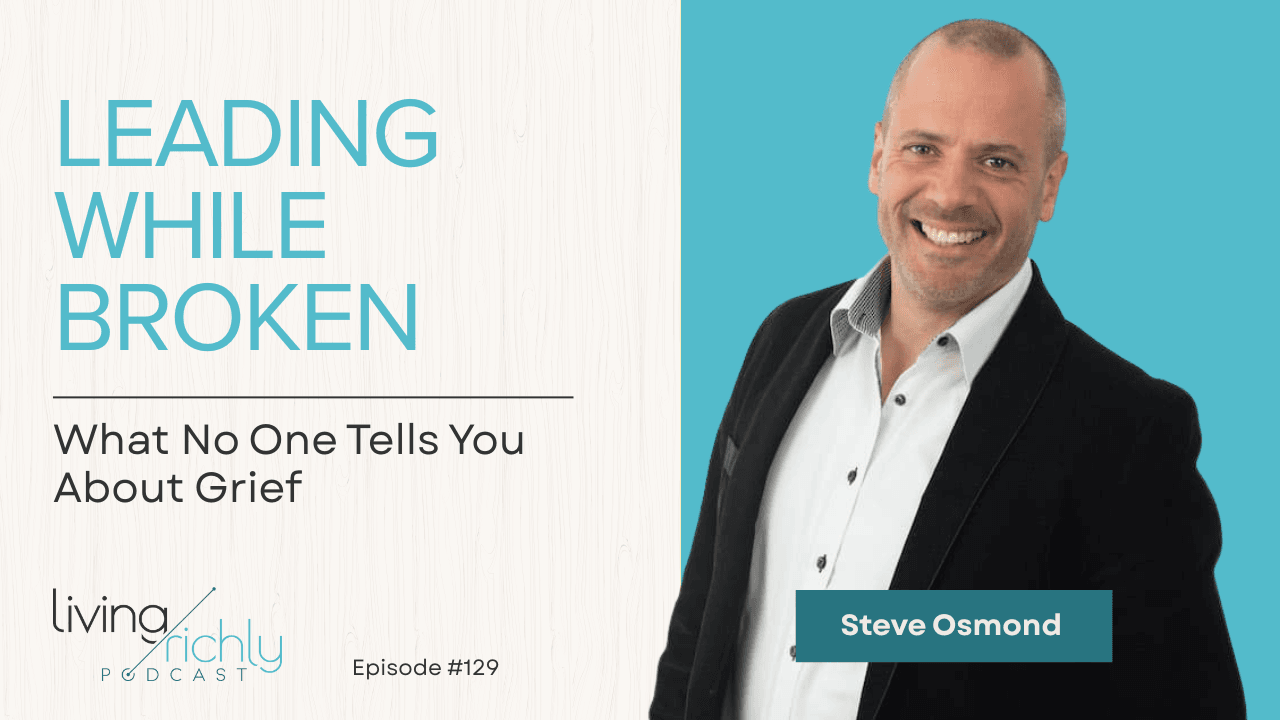


Leading While Broken – What No One Tells You About Grief is a powerful episode of the Living Richly Podcast where Rob and Eric sit down with coach Steve Osmond to unpack how grief transforms leaders from the inside out. In Leading While Broken, Steve describes the shock of realizing the “strong leader” script collapses under real loss, and how pushing harder only deepens the wound. The conversation explores the grief leaders can’t step away from, the changes your body forces on you, and the inner “coffins” we build when parts of us must be laid to rest.
This episode invites listeners to slow down, reflect, and redefine what strength looks like when life breaks you open. For leaders navigating heavy seasons, this is a roadmap toward honesty, capacity, and healing.
Show Notes for Episode 129
👉 Join our private Facebook Group now for exclusive content: https://liverichly.me/livingrichlynation
Connect with Steve
Episode 129 Transcript
Ep129 What No One Tells You About Grief
Steve: [00:00:00] Three men that I really cared about. I saw them in a coffin this year when I was feeling loss. I was also aware of, oh wow, I am so blessed and so happy that I had a opportunity to love so
Rob: deeply. I have to show up, I have to be strong. I have to be the guy with all the armor on and no show, no weakness and all of that.
That’s how we
Eric: honor them, is by continuing to live our lives fully and becoming that best version of yourselves. Alright, beautiful.
Rob: Hey, welcome to the Living Richly podcast. We’re so glad that you are here with us today. I think this one’s gonna be an emotional one. We are talking again about grief and. For many people when they experience grief, they’re, they just life pauses for them. Yeah. Not for leaders. When a leader goes through a series or a season of grief the emails keep coming in, the phone calls are there, the staff are asking questions.
The business [00:01:00] still needs to run, and we’re gonna talk about what it’s like to walk through grief. And continue to lead in an organization should be pretty powerful.
Eric: Yeah. And we’re so thrilled to have our coaching colleague from Rhapsody back with us all the way from Calgary for today’s show.
Steve Osmond. Steve, you’ve gone through a season and a season of deep loss and we’re so honored that you’re willing to come here and talk about what your journey’s been like. ’cause I know it’s gonna be powerful. We haven’t actually tackled the subject of grief head on. It comes up all the time in episodes.
But since episode 65 and 66 with our great friend, dear friend, Don Lasso really looking forward to approaching this from the angle of leadership and grieving while you’re a leader. Great to have you here, brother.
Steve: Thank you. I am
Rob: sad and happy to be here. Yeah, that’s a great way to put that.
And yeah. And I do encourage you if you haven’t watched those episodes with Don LaShon such a tremendous way to view grief. I think he turns a lot of the [00:02:00] preconceived ideas and models on their head and really gives people permission to grieve in their own way. Yeah. And to embrace what grieving really is about.
So encourage you to check out those episodes. We, all of us around this table have decades of leadership experience. We have been, I think all three of us have been leading two literally since our early and really since our teens. Yeah. But certainly right from the time we became adults, we have been in some kind of a leadership role.
Steve maybe let’s start out with what is one of the things about leadership and grief that surprised you when you first experienced it hit you in the head and caught you off guard when it came to grieving as a leader.
Steve: I think the biggest thing is that even though you are intellectually aware of what’s happening, like the, this is someone’s died, someone’s gone.
The emotional part doesn’t cooperate with the intellect. That’s, I think that’s the biggest challenge. It’s [00:03:00] intellectually I know what to do, I know what’s happening, but there’s this wild frontier of emotions that are really unpredictable. Yeah. And can’t be controlled by logic. I think a big adjustment for me was under understanding that, whoa, I’m gonna need to buckle up for a long ride on the emotional side.
Intellectually. Yep. I know exactly what’s happening here, but then the sneak attack by emotions when you least expect that, that I knew that was going to happen. Intellectually but how do I actually handle it when it is happening? When it shows up. When it
Eric: shows up. And of course, you’ve had a year, right?
Like 2025. You’ve experienced a lot of loss. You, your dad passed away earlier this year. I think I’m gonna get this. Sequence right. Then followed by your uncle that you had a unique relationship with, and then your nephew more recently. So three losses back to back. What’s that been like that, that whole journey for you?
Steve: I, as I try to frame [00:04:00] my thoughts, I think about three coffins and three men that I really cared about. I saw them in a coffin this year. My dad in January of of this year, my uncle in June, and my nephew in August. And of course all three of them are unique. A man’s relationship with his dad is one thing.
With my uncle who was also my boss. I, when I was for many years. Yeah. For many years. He was the boss that I worked for God, it was my boss, and then he was my second boss.
Rob: And then sometimes they got, and they got very mixed up. Yep.
Steve: And then my nephew, which was a completely a disas a tragedy, a drowning.
So I, even now in my mind, I can see my dad in the coffin, my uncle in the coffin, and my nephew in the coffin. And it’s very intense. And very overwhelming and very layered to experience all of [00:05:00] that in one year. I’ve never experienced a year like this in my life. You mentioned as a le as leaders, as a pastor, and as a coach I always knew how to be in someone else’s world when they were grieving and the right words to say and what not to say and how to respond and caring for people.
But it was al there was always a little bit of distance, professional distance, that, that kept me. I think maybe unconsciously kept me safe from the pain. It, you can’t dive into everybody’s pain that you experience in life. So there is a little bit of distance that we all have when it’s someone else, but when it’s yourself, when with me or at those coffins and me experiencing the grief that professionalism washed away, disappeared.
Yeah. That distance was gone and I was right in the middle of it. And probably the compound, the compounding grief [00:06:00] of three significant figures in my life and complex figures our relationships with our family. Mine is very complex ’cause there’s a lot of family expectations and family disappointments.
All mixed up with my past career as a minister, as a pastor, and yeah. All of that world, all of it comes flooding in both the good and the bad. And it’s a really deep time of searching and questioning and and at the same time, and not to get co go too far down the road on this, it’s really beautiful.
It gets really beautiful to have loved people deeply. Yeah. It’s really beautiful to to feel lost because when you feel lost, when I was feeling lost, I was also aware of, oh wow, I am so blessed and so happy that I had a opportunity to love so deeply.
Rob: And I think, I love how you frame that.
And I wanna land in on. Again, as we’re talking today about as leaders [00:07:00] and how do leaders handle grief and lead and to, to your point, we, all of three of us as former ministers, we’ve been by, we’ve been at the bedsides of many people who have passed. We’ve gone through that and you’re right, there is a comforted many
Eric: families, right?
Many families.
Rob: And there is that professional disconnect that happens no different than a doctor or a paramedic, right? Many of them have to do that same experience and then it hits home on for ourselves. And yet, I love what you said at the beginning. We, in theory, we teach that grief happens a, check this box and do this and that’s how we even care for others.
Then it hits home and you’re torn between. As a leader now people are watching to see if I grieve according to the boxes that I’ve taught. And now I have to grieve differently. And I, we’ve all used the scripture we grieve and we do not grieve. Like those who have no hope, right?
Then suddenly I’m like, but no I’m fucking [00:08:00] grieving. I have no hope when, I think of when my daughter died. Yeah. And having that experience how did that show up for you? How did you wrestle between and maybe you didn’t, so maybe I shouldn’t assume it. Did you wrestle with the notion of people, family, others are watching me process this?
I have stated, XY like how do I continue to show up as a leader who focuses on whatever and grieve.
Steve: That is I would say the first thing that comes to mind are, first of all, the voices in my own head. So before, yes, there’s some expectation from those around me, but the inner thoughts and voices of expectation of here’s what you do, Steve, and here’s how you handle it, and here are the steps that you take.
And so I was cold to myself. Yeah. Not, cold’s not the right word. I was professional to myself. Which you were trying to pastor yourself like you did so many other people. Yeah, exactly. I was, again, that [00:09:00] dichotomy or that tension between intellectually knowing what you need to do, but allowing the emotion to be there and have its way and run its course.
I was aware of family expectations, I was aware of probably as a leader the switch that would click lots of times was, oh, I still need to be there for my clients. I still need to be there for my sister who lost her son my nephew. Yeah. I still, I need to be there for my mom. I need to be there for my, my cousins, my family, I don’t think that’s wrong. I think it’s good to think about that, but I also needed to make sure that I was facing my own grief head on as best you
Rob: needed. You needed to be there for you. I needed to be there for
Steve: me. Exactly. And I needed to be there for me with tenderness, not professionalism.
So I I might maybe lecture myself or some of those scripts, rub some dirt on it. Yeah. Yeah. Chin up and stiff upper lip. And people have it worse than you and
Rob: all [00:10:00] kinds. That’s a big, that’s a big, yeah, exactly. Co compare the, we’ve talked about comparison game. The comparison game with grief Yeah.
Is such a ridiculous thing. Yeah. And yet we do, many of us do. Yeah. It
Steve: was interesting on Remembrance Day in November of this year I’m at a Remembrance day ceremony. And of course. Tens of thousands, hundreds of thousands of people died and never came home. And the stories of grief and loss are so intense.
And then this little script is yeah, why are you such a baby? People were in the trenches and they were crawling through mud and blood and through barbed wire and suck it up. And thankfully that didn’t stay very long. It’s oh, I know what, that’s just some weird finger pointing inner critic that is trying to give me a lecture.
And when reality is, everybody’s grief is unique. A hundred percent. I can’t compare to what somebody else. Has experienced, I can only experience what I experience and I’m allowed to experience what I’m, I experience, I’m a human. [00:11:00] Yeah. I’m in the game of life. Yeah. And I get to grieve.
Exactly. And I, I don’t get dismissed or just disqualify because my grief is different than others.
Eric: Yeah. I think a lot of you’re hitting such an important point there that giving yourself permission to grieve I think is for leaders a difficult step because we feel the expectations, the need, the responsibility, the weight on our shoulders to continue to shoulder on and muscle through these difficult periods of our lives.
And let’s face it, grief isn’t, we’re talking about very significant losses, family members that you lost this year, but grief, we could be mourning the loss of a job, the loss of our business, the loss of a goal that we had set. That friendship didn’t work. A friendship, their loss shows up in all kinds of ways.
And we often. I loved how you’re describing the tension between the intellectual and the emotional, where we know that this is a loss, but we struggle to give ourselves permission to feel it. And one thing that I wanna make clear we talked about this on the [00:12:00] episodes with Dawn Donnie. Way back, like 70 shows ago.
But it was Elizabeth Kubler Ross in 1969 who wrote a book on death and dying. And she was the first to identify what had become known as the stages of grief, the traditional stages of grief. And I’m not gonna get them in the right order, but there’s a, there’s what? There’s anger, there’s sadness.
There’s I’m not gonna get ’em right. Negotiation. Accept acceptance. The last one. Acceptance. And so people look at that and say, that’s the right way to grieve. And what they don’t realize is Kubler Ross wasn’t trying to, she was studying people that were on their death beds.
These were people who knew they were dying. So the pattern she described was before death for people who were dying, not for people who were mourning the loss of a loved one. But somehow that has made it into the world’s vocabulary that this is. How I have to grieve. So not only do we struggle and I think leaders struggle even more.
And what comes to mind for me in this moment is not just leaders who have an official leadership role. Either they’re a business [00:13:00] owner, an executive and a, or a manager in a company. But think of that family member that when there’s a loss, rises up into that leadership role to take care of everyone else.
And almost their grief gets suspended and delayed till much later down the road. And often, we were talking about this yesterday that often when you’re a leader, because you step into that role to take care of others, your grief goes on pause in many ways and often doesn’t hit you till four or five, six months later.
And when the feelings show up. The emotion of it shows up, you can’t connect it to its source. And so all of a sudden now you’re thinking, what the hell’s wrong with me? Why, where did my motivation go? Why can’t I get myself out of bed in the morning? What’s this dark cloud over me? And becomes even more confusing to process.
Rob: And I like what, you’ll often joke around about, you’re a slow learner when it comes to burnout. And no, I’m not a slow learner. You just No, I just, I’ve really applied myself and I’ve taken the course several times. You’ve taken the, yeah.
You’ve taken and it was interesting ’cause we were having that conversation. I’d [00:14:00] like you to unpack it a bit, Steve, around when grief did hit because there was a season, it took a little bit of time before it started to really materialize. And I reflect back again. I remember when Katie died, my initial thoughts were similar to what Steve had talked about, where I was thinking, man, I need to be there for.
I need to be there for my wife. I need to be there for my for Brit my, my daughter. I need to be there for the church. I had to show up and start, pr pastoring again. And so it, I was a slow learner there. It took me 20. Plus years to finally recognize that I had never actually grieved, I had bottled, and because I was a leader, I was, I need to be strong for others.
I still have to run this ship. And so it wasn’t until I was long out of that world that I finally got to a point of realizing, oh, I haven’t processed this now, and I’m still processing it to this day. It’s still now the, I know that [00:15:00] I go through those stages now. I don’t have the emotional like where it hits, but you’re processing it for you.
Talk a bit about that journey of from when the mo, the day those happen, boom. Over the course of about six months from there to today, which we’re talking now another what, three months. What has been the process over the three months to where you sit today?
Steve: I think the a, a really key word is for leaders to focus on and humans is the word energy.
Because that’s where a lot of our behaviors and our words and even our emotions come from, is what energy are we living in? And this is where I think we, we really move from the unconscious to the conscious. So grief can live back here, right Rob? It can be or Eric, three or for three or four months, it was living back here and all of a sudden it spills out in my behavior, in my words.
And I might get angry or I might, who knows, shut [00:16:00] down or go into harmful or destructive habits, whatever it might be. And a lot of it is because. It’s back here.
Eric: Yeah.
Steve: And the courageous leader says, okay, I’m gonna bring that emotion from back here into my conscious and think about it and talk about it and journal it and admit it and share it.
All of that is really good. And so when I take it, when I take it from back here to here, I think, okay, what energy do I have? And then I want to honor the energy. Then also be aware of, okay, that’s great. I’m feeling energy. ’cause grief energy’s re really a low energy of all of the, anger, pride, lost fear all those energies.
Grief is a really low energy. Yeah. Like it’s a lay, it’s a lay around, be in bed. A very low frequency. A low frequency. Yeah. The vibe is really low. It’s and it’s very close related to a sort of [00:17:00] a depressive feeling. It’s not quite depression, but you could go into depression.
Yeah. But it’s in that category. And so then you say, okay I’ve got grief energy in my life right now, so I’m gonna honor it and find space to honor that. And then I look at, okay, but my reality says I gotta deliver. Yeah. And that doesn’t go away. And if I ignore it. There’s a price to pay and sometimes the price is the price, and you lose the client, you lose the momentum, you lose the whatever, and sometimes you just say, yep, it’s a year of loss for me and I’m gonna lose some things.
However, you can’t completely go off the grid. You can’t, unless you’re independently wealthy and unless you’re independently wealthy. Yep. And I think that’s, I think I don’t want people to miss that because I think sometimes the, we might even guilt the leader into. Saying, you’re not grieving, [00:18:00] right?
Because you’re still working or you’re still delivering and I don’t think it’s either or. I think it’s both. And I think you say, okay, I’m in grief energy, and so I need to find the right space. So with me, it’s with Crystal or in a grief group that I’m a part of or spending time with friends or journaling the grief energy.
But then I need to, from as much as I am required, I shift into, I, like I just call it courage. It is different than pushing through. It’s different than stuffing grief down or ignoring it. It says I have low grief energy, but I’m gonna be courageous today and move into client calls following up on emails.
But I also give my myself permission to not be as. Energetic, right? So I’m slowing my pace and allowing myself to do what needs to be done, but I’m gonna do it at a slower pace. You’re not showing up
Rob: at grief energy [00:19:00] level, but you’re not maybe showing up at normal, Steve.
Steve: I wouldn’t say it’s high perform.
I’m a high performance leader. I would say I’m a courageous leader that keeps doing what needs to get done, recognizing that I, I’m leading with a limp, or I’m leading with a broken heart. I’m leading with tears in my eyes or whatever the metaphor is. It’s true, but I’m still leading.
You’re still leading. And I, one metaphor is, the, there’s the Germans say there’s a saying that a person is built close to the water, meaning they, they cry easy or tears come to their eyes easily. And I’m built fairly near the water that’s, I’m not right next to it, but I’m a couple blocks away.
And you can see the river. I can see the river from here. And so with that metaphor in mind, sometimes I head to the river. I go there and, I cry, I put on the songs I and what I think for leaders, we don’t [00:20:00] want to avoid going to the river, go to the place and cry and grieve and journal or a therapist or or whatever.
It’s whatever it is. But then also with tears in my eyes, I leave the river and I go into the world. That requires some level of Yeah. Work from me. Yeah. Some level of production. But I’m still dripping. Yeah. From the river and there’s still water in my eyes, tears in my eyes, but courageously, I do it.
But I
Eric: think honoring the emotion is honoring the emotion is so important. Yeah. You I think grief again, is one of those funny emotions that most of us see as a negative and we have a complicated relationship with. I think, I know for me, another complicated relationship I have is with the anger emotion.
But we tend to see those as negatives, so we try to we know we need to grieve, but there’s this notion that I don’t like this feeling, I don’t like this energy in my [00:21:00] life. And so we fight it. Instead of what you’re suggesting, which is learn to dance with it, learn to embrace it and understand that it’s gonna come some days it’s.
Kind of in the background as just as a little bit of a fog, a low hum in the background, of
Steve: grief.
Eric: And then other days it’s like front and center and it’s a heavy blanket. Jim Harrington, my mentor calls it when we’re showing up in that kind of way as leaders, where for some reason whether it’s grief or we’re walking through a big challenge of some sort where we’re just not at full steam.
He calls it just having one ore in the water. He goes, it’s, you’re not there on those days to win any championships or set any records or any personal vests. You’re just gonna show up and with one oar in the water. Now I always joke with him, I said, but Jim, if you have only one oar in the water, you’re just gonna go around in circles.
And he would laugh. He said, what he means is we’re not trying to muscle our way through. We’re giving ourselves that [00:22:00] permission. To be human. And I think if there’s any leader listening to this right now who’s currently grieving our message to you is it’s okay to not be at your best all the time.
You’re human, you’re not a robot. You feel and allowing yourself, it, it’s a, I loved how you’re refer to the beauty of it. When those moments come and they often come at the most, let’s be fair. The worst of times. Sometimes they’re convenient, they show up. Grief shows up when you’re by yourself right by the river maybe, or on a walk or at home in the morning drinking your coffee, and you get hit by a wave.
And so it’s easier in those moments to honor the moment, honor the feeling. And in so doing, you honor the memory. I think grief is a gift to us to continue to honor the memory of the person that we’ve lost, right? Or the moment that that, that has happened.
Steve: One little. I think finding words is helpful, right?
Because grief, [00:23:00] anger, what? Oftentimes that’s a chaotic swirl of, different thoughts and emotions. Some are good and some are lies, and some are helpful. Some are harmful. So it’s good to find some words. I’m only three months away from the latest tragedy, which was the biggest, all of them were losses, but this was the one that was the shock, right?
A 20-year-old drowning in a lake, terrible with his friend. Both of them drowned together. And it, it’s a nightmare. It’s, yeah, it’s horrible. So I’m only three months removed from that. I’m not removed from it. Three months past it. I’m not removed from it, three months past it. And so that’s really fresh and really raw.
But I have had a really beautiful thought the last couple of weeks around wanting to fe wanting to feel happy and with, so when that wave of grief. Comes, it’s oh, get rid of that. I want to get back. I want to be happy. I was happy 10 minutes ago. Why am I not happy now? Yeah, because I’m [00:24:00] remembering and feeling, and I found a really little, just a beautiful word that made me understand.
I don’t need to be happy. It’s this word satisfied. And what’s better? A, a happy life or a satisfied life? Happiness comes and goes and you love it when it’s there, but it’s not, we’re not always gonna be happy, but we can be satisfied or have a sense of satisfaction. Am I still living on purpose?
Do I, am I still staying true to who I am? Am I loving the people around me? Am I living the life the way I want to live it? Whether I’m happy or not? That’s fine. So that little shift I wrote in my journal I wrote and Johnny Cash. He sings a song a satisfied mind.
I could have this, I could have that. I could have money and gold. But what I want is a satis satisfied mind. And that’s a really beautiful thought, which is a more grounded. Emotion than happiness. I’m a [00:25:00] little bit of a happiness addict. Do I chase the dopamine, chase the thrill cha, like playfulness is one of my core values.
If I’m not happy, something feels out of order. I, let’s get happy again. Let be happy. Yeah. Yeah. And but happiness is unpredictable. But grounding yourself in, oh, am I satisfied with who I am in my life? And that’s, so that’s a really, that’s a powerful place when you
Rob: can get there.
And I so appreciate you, you talking about how the words and in, in so much in grief, it’s about identifying exactly what’s going on by naming it. And when you name something, now you can work with it, then you work with it, and you can embrace it and you can take it in.
And so whether it’s grief or anger, often, and especially guys we have a hard time naming the feeling, naming the emotion. And so then that’s why we wrestle with it so much. And even as leaders, because here’s the other side is leaders can say, I don’t want to sit at [00:26:00] the river. I don’t want to experience this.
I’m going to just dive in and keep busy to protect. Myself from the grief and the pain. And I think that’s such an important piece to recognize.
Eric: A hundred percent. You talked about earlier, and I think we all can intellectually accept the fact that, we know grief can live back here in the subconscious or in the, in what I call in the shadows of your life where you’re trying to keep it at bay.
Very true. You’re trying to outrun it, you’re trying to outperform it. What is one of the most common things that leaders do when they’re struggling? Again, whether that’s because they’ve lost a loved one and they’re in grief, or they’re having challenges at home in, in their primary relationship perhaps, or maybe their kids are they have a strained relationship with their kids, whatever the challenge is, what is the common denominator that we see?
Is a lot of leaders, a lot of founders, a lot of entrepreneurs just double down on work because they feel. Many. I think if you get ’em one-to-one will acknowledge that I’m not, I [00:27:00] don’t know how to do this grief thing. Like I, I feel incompetent at it. Like I don’t feel like I’ve got the skills.
I don’t feel like I’ve got the emotional acuity to be even able to name what I’m going through. And so they then double down where they do feel confident and all they end up doing is delaying and worsening the problem. Because grief, like any emotion, we’ve talked about this frequently on the show, the word motion is in that word emotion motion, right?
They’re meant to move through us, and when they don’t, they get trapped in our psyche and they become something else.
Rob: I love that you used the word problem there. And because right away it got me thinking again, as leaders, what’s one thing that leaders like to do? Solve problems. And so we see you can’t solve grief.
So if you see grief, if you see grief as a problem, wow. All of a sudden now it’s, okay, there’s my problem, now I’m a leader. Let’s solve it rather than sit with it. And we need to now go. So I love, as soon as you said problem, I thought, yeah. And leaders [00:28:00] like to solve problems. That’s one of the challenges.
That’s a
Steve: great perspective. And again, that’s one of those perspectives that, that really helps process is something like, just like that is, is oh, this is not a problem. And shifting your belief around that,
Eric: it’s not a problem, it’s a process. Yeah. It, yeah. So it’s not a problem to be solved or avoided or to run from.
It’s a process to walk through. And I loved you, you’re talking about, I want to get back to my happy place. And we often do that where, when we’re going through hardship especially grieving. Something or someone, dear that we have lost we want to get back to quote unquote normal.
And for those of you that are listening, I’m doing air quotes with my fingers right now. ‘Cause I know not everyone watches the show on YouTube. A lot of you listen through all your favorite platforms. But we want to get back to life as though it’s normal. And that’s almost a misnomer because the grief, I believe that like any emotion when it’s.
Processed when we learned to sit with it. And I remember what Sherry [00:29:00] and Jim years ago told me both independently, that I needed to learn to sit with my emotions. And my response was, fuck you both. I don’t know what that means. What does that even mean? Mean? What do you mean sit with them? Do I invite them over?
Do I serve the coffee and puppets? I don’t know what that means, but years later I do. Now I understand is to truly not try to overcome it, not try to work my way through it, but let that process, it’s not about getting back to normal, it’s about actually moving through it, honoring the loss, honoring the emotion of the loss.
Honoring the lessons that you are learning through it and adding to your wisdom and coming out on the other side of it. Not back to normal ’cause No, let’s be fair. Often normal’s pretty fucked up anyway, right? Yeah. It’s about that evolution that can happen in our lives.
Steve: And I would say that when you lose someone you love to death or when you lose a best friend because of [00:30:00] conflict or you lose a business there that never goes away.
So that now is the normal. The normal is, yeah, I, this thing or person that I loved or was a key part of my life is no longer there. I’m not going back to normal. This is now the normal is my dad is gone and he’s not coming back. The normal is that my uncle Ken is gone and he’s not coming back.
The normal is my nephew. Kaylin is gone. He’s not coming back. And, that’s still okay. It’s horrible and it’s sad, but I’m. I’m learning that Oh, in spite of that or not, in spite not the right word in the awareness of that, there’s still a way to live a satisfied life, and which may not always be happy, but there still can be satisfaction and peace and courage and acceptance that can still be there.
Yeah.
Rob: It’s interesting. The word that comes to mind right now on this is as is right out the title of a book That was [00:31:00] absolutely a game changer for me. And that’s untethered. Notion of, so with the untethered soul, the idea that where you find that satisfaction, where you find that ability is when you untether yourself from the power of your emotions, of your grief, where you can look at them, you can experience them, you can sit with them, you can walk through the experience of them, but you’re not tethered to.
Those emotions where they can pull you, you’re instead in control of them. And so as you go through that grief, you can sit and go, okay, now I’m going to sit by the river for a season and now I’m going to show up for my clients. I’m not tethered to any of those emotions. I think that’s such a powerful illustration.
Yeah. They’re moving through me. They don’t own me. Exactly.
Eric: And even sometimes they move quickly. I remember I lost my dad in 2008. He was only 66. Was a relatively healthy guy and then got diagnosed at 64 with stage three adv, advanced stage three lung cancer, never [00:32:00] smoked a day in his life.
And then I watched my dad go from this strong capable, able-bodied man. To basically waste away and fought a courageous battle. But that was a tremendous loss for me. And I still miss them to this day. That’s now almost 17 years now. Actually it is 17 years. It’ll be 18 years in in just a few months.
Those moments, like when you, when the grief hits you sometimes it passes quickly, sometimes it moves fast. Other times it’s heavy and it’s like a, it’s like a heavy fog and there’s no wind. So the fog just stays with you. But again, getting present to it as opposed to fighting it, moving it from here to the, in your subconscious or, when. Here’s the deal. You’re going to deal with grief one way or another, and it comes
Steve: out one way or another. It comes
Eric: out one way or another. You’re going to deal with it. Avoiding it is not gonna solve any problems. Matter of fact, it will worsen things because grief will find a way and it’ll break.
And it’s like you ever, [00:33:00] it’s amazing to me the power of nature where you can be walking down a sidewalk, a concrete sidewalk, and little dandelion is breaking through the concrete. Like these fragile little plants, it seems can just take over, right? Grief is like that. It’s like that dandelion.
It’s to gonna find a way up. And usually when it. Comes out like that, it’s going to be less healthy. And because you’re not present to it, again, you can’t put your finger on what’s actually happening. So it’s really hard, even intellectually to understand what is happening to me right now. I’m curious, I wanna ask you this question ’cause I think it’s a challenge a lot of leaders face.
We were just talking yesterday about leadership in general. We’re gonna be recording some shows today about leadership as well after this episode. And I look forward to that. But one of the myths that leaders carry is this notion that if I don’t show up at a hundred percent of the time, this whole thing might just come crumbling down.
In your grief journey, what things have you held [00:34:00] on to more tightly, and what things have you learned to let go or drop, at least for a season to give yourself more room?
Steve: To help me process this. I created a three coffins for my inner world. So I had experienced three deaths in my family.
So to help me make, bring some order to that I said, okay what’s, what do I need to let go of? What do I need to bury? What do I need to put in a coffin in this season in my own life? Because I’m learning to let go of loved ones. What can I let go of? One of them, one of those coffins is directly answering to your question, which is, what expectations do I need to put in the coffin?
I’ve immersed myself over the last 10 years in high performance. Actions, beliefs, behaviors, words. It’s whether it’s helping people [00:35:00] have a high performing business, a high performing team. That’s the world we live in. Or a high performing professional as just as the business owner or the executive, which is wonderful.
Like high performance is beautiful, high performance athletes and high performance musicians, high performance business leaders. Yeah. We
Eric: admire
Steve: all that. All that. That is wonderful. Yeah. Yeah. And it’s a part of the advancement of civilization. Yeah. And making the world a better place. But when you’re grieving when I, now that I am in this grieving, I am letting go of the high performance expectations.
So that’s going in the coffin very practically with what does that look like for you when you say that? Yeah. Very practically, how I live my day. So the expectations on my energy for the day has changed. So I had a really, a wonderful, powerful high performance morning. It’s like an atomic morning, a nuclear morning, which included like getting my game face on and [00:36:00] mantras and sit ups and stretching and podcasts in the morning. My brain is alive, my body’s alive, and
Rob: Wow. Yeah. Charging to the sta
Eric: charging to the stadium, yeah. And apparently lots of caffeine.
Steve: Oh yeah. Yeah. And it’s kicking in now.
I dunno if you can tell. Yeah. Which again is a wonderful part of life. And also that does not serve me right now. That’s where I’m, now I’m putting myself in a place where I’m stretching myself too thin and I could get into a dangerous place of burnout or exhaustion or whatever it is.
Moving the expectations for my day. So that’s one practical way. And then also moving the expectations for what I can get done in a day. So that’s really practical. So let’s say there was 10 things I could do at high performance level reach out, emails, client meetings, training [00:37:00] sessions, whatever my day might be is, oh, I can’t do 10 anymore.
I’m probably at a five level, and again, back to that word satisfied, I’m gonna be satisfied with a five,
Eric: one, or in the water.
Steve: Yeah. One or in the water with a five.
Eric: Yeah.
Steve: A little mantra or prayer that I learned a couple of years ago at the end of my day, which, which never had as much meaning, meaning as it does now that I’m in this grief part of my life is, I think it’s attributed to Peter Drucker, and he, at the end of the day says I sold what I could sell.
I changed what I could change, and now I’m at peace with it. That’s the end of the day. And then tomorrow I get to get up and wash my face and have coffee and get going. But at the end of my day, I say, I sold what I could sell. I changed what I could change, and I’m at peace with it.
Eric: But that requires and I love that.
I love the ability [00:38:00] to I tell my clients all the time, there’s two things that every leader, every human, but especially leaders, need to manage for themselves that nobody else can do for them, which is to manage their expectations of themselves and others. And often it starts with a line that Sherry often a question she often asks me when I’m being a bit unrealistic is, are my expectations in line with reality?
So we need to adjust our expectations and our energy. Those are two things that no one else can manage for us. So the ability to ratchet down or dial down and be okay and not just understand that’s. That’s okay today. But there’s some leaders, like fundamentally the belief is that’s not okay.
That’s, I’m underperforming. I’m letting people down. I’m letting my team down. I’m letting my clients down. And this whole thing literally it depends on me. What would you say to that leader who is struggling just to believe that’s even a possibility? [00:39:00]
Steve: I think that energy is a drive energy, which is good.
There’s some combination of fear it will all fall apart. There’s some kind of lost or craving achievement drive I want to get, I wanna earn, I wanna achieve. And then there’s also some sort of a pride energy, like what will people think if it falls apart or if I don’t measure up?
And I think those three emotions are fine short term to help us get moving and going. It’s take off fuel. Take off fuel, but long term toxic, it is toxic. And even more so when we’re grieving,
Eric: right?
Steve: And I’ve already mentioned this, so I don’t wanna repeat myself. So I would encourage those leaders to think about being courageous as a goal, not being driven or pushing strong.
’cause courage includes letting your team know that you’re. Or that you’re sad. Courage includes stepping [00:40:00] back when you know it’s time to step back. But courage also gives you the ability to push when you need to push. I would say to these leaders, be courageous in the full circle of courage.
Which means being courageous enough to stop, slow down, rest, cry, get a therapist, get help, re reach out. That’s courage. Yeah. But courage also moves the. I’m gonna pick up the phone and call that customer. I’m gonna, I’m gonna do that administrative task that’s, I’m trying, I’m avoiding it. So courage is a really good energy to to make as a goal.
And it, to me, it’s similar to that word satisfied that I was using earlier. It’s in that category. It’s a more healthy energy that moves us as opposed to all this drivenness and fear and pride and anger.
Rob: I love that and. There’s, you’re right. It getting that, shifting that mindset is so critical and so important.
I want, I wanna revisit another, we talked about it a [00:41:00] little bit but it’s a myth that a lot of leaders have. And that is again, the notion of I have to show up. I have to be strong, I have to be the guy with all the armor on and no show, no weakness and all of that. You had a very powerful moment where you came out with your grief, you went public with your grief and you shared that openly.
Maybe talk to the motivation or the reasoning behind that. And just as importantly, I’d love to hear be what was the response? For that ’cause I can I’m gonna make an assumption we haven’t actually talked about it. I’m gonna make an assumption of what that is. And I think it’s important for leaders to hear this is when we do come out with our grief we may be surprised at how people respond or maybe share a little bit about what that experience was like and what was the response.
Steve: Yeah. And that’s the second coffin. Actually. The first coffin is what do I need to bury in terms of expectations? I was
Eric: about to ask you, we only covered number one. Yeah. Yeah. I don’t want the other two. Yeah.
Steve: Expectations. So the second coffin will be holding my silence. [00:42:00] So suffer in silence.
And I don’t know where that came from in my life. Family of origin, being a minister other, some sort of professional detachment. But suffering in silence was my go-to and I did that. I would say it like if someone was, if someone asked me how you doing with the loss of your dad? And I just knew the nice little admit admission phrase that shared nothing.
Just yeah, it’s been tough, but, how are just enough to acknowledge that I’m not complete denial. I am aware that someone died but I’m not going to say much about it. So I was I was reflecting on, doing some journaling and that was the one thing that, by the way, I didn’t stop when I, my high performance stuff, rah, game phase, pushups, all that.
One of the things I kept was the journaling piece. My journaling is very simple. I have four post-it notes in a journal, and I write four brief thoughts. I’m not good with the long form. Just [00:43:00] four brief thoughts and thi this idea came to me in my journaling that, I shouldn’t waste this moment.
Many other leaders are experiencing what I’m experiencing and this is not a moment to be wasted. So that’s when I decided, oh, I’m going to come out and I’m not gonna suffer in silence. I was aware that was, that would be both therapeutic to me, and I was aware that it would be helpful to people.
It wasn’t very dramatic. I just wrote a series of articles, LinkedIn posts faced in posts Facebook posts that expressed what it was like to lead while grieving, doing difficult tasks while grieving, doing having challenging conversations while grieving, and just some reflections on that.
And then also, this is a just really simple with my partner Crystal. Rather than suffering in silence, I would say, Hey, baby, I’m sad today. I couldn’t say, I couldn’t say that before. [00:44:00] Yeah. Wow. That that I had to keep that in. And just to say I’m sad today was, I don’t know, it sounds silly now, but I, that was a big step for me to be able to tell somebody I’m sad.
I don’t know why. I don’t again, as leaders
Eric: and I so appreciate. Yeah. I think this is a beautiful moment that’s happening just right now. We’re not we feel like we’re not allowed. Yeah. And that’s why permission. Yeah. I think there’d be all kinds of people that if they knew we were suffering in silence.
That’s been my go-to as well and it’s been hard to overcome that and still a script that in moments that are hard. I still have to be strong. So you feel like I just can’t show that, but the ability to open up about it I’d love to hear more. Even briefly before we hear about the third coffin. You talked about a support group, a grief group that you joined.
Steve: A great que in response to the second part of Rob’s question, people’s response have been wonderful. Of course. Not everybody, but so many people sent a [00:45:00] note or or I went to one five, five behaviors of cohesive team training, all day. Training. Training with this group of construction men and a couple of women as well.
Just a, tough hard-nosed bunch of construction workers. And it again, in that moment I decided normally I would deliver that very professionally, the principles. And I said, I thought, oh, I’m gonna tell them. About my year of loss. And so of course, immediately, not shockingly, there’s six or seven other people in the room who’ve just lost a loved one or they’re in grief.
And now while I have some tears in my eyes, they have some tears in their eyes and the level of connection deepens and and then afterwards privately, thank you for sharing that and that, that was really helpful. And just finding that you’re not alone. And the group was, the group that you were just asking about is called Grief Share, which is a church based a aa vibe, but a couple [00:46:00] notches more higher towards God as a part of the process.
And so it’s a 12 week. Course of how you can am I, it says things like, am I normal? Which is the one of the first things that I was asking. Should I be crying more? Should I be crying? Should I be crying less? I doing right? Am I doing, am I’m grieving wrong? Am I normal? What do you do with anger?
Handling your family while you are grieving. And then there’s one session on God, whereas, which is a great thing to reflect on when you’re grieving. Yeah. What happens after you die. And some good guided questions around that as well. So that’s been really it’s a really beautiful program.
Rob: We’re going to start to, in a moment we’ll begin to land this plane. I do want to have each of us just share what, yeah. You talk. I know. I’m gonna get there. Okay. I want us to share, I’m curious. Yeah. I’m gonna ask you about the third coffin. But after we, we’ll each be ready just to share what’s one thing we’d like to say, and we’ll speak right into the camera, speak to leaders about again, an encouragement, but very [00:47:00] quickly what’s the third coffin?
Steve: The, it’s the coffin of regret. Okay.
The, any sense of what if I should have if only I would have that, that ca that I’m, I allow myself to think about that for a little bit. It’s ’cause maybe there’s some lessons that you can learn by looking back. So I don’t wanna. Clear my brain of it completely, but I cannot control how much time I wish I would have spent with my dad or how much time I would wish I would have, or I wish I would’ve had this conversation.
I can’t go back. The past is a it’s gone. And while I reflect on that and learn a couple of lessons that’s not, that can’t be where I live in my thoughts. It’s okay. I’m letting that go and how now shall I live? What’s, what now will my life look like in light of loss?
So letting go of regrets. I think for me, that [00:48:00] was not really difficult. That was, but I had to do it consciously. Yeah. For, I think for other people that I’ve talked to, letting go of regrets is a real fierce challenge. ’cause there are some things left unsaid. Yeah. Unforgiveness or I never got a chance to say goodbye or whatever it might be.
So I’m very aware that for others that might be more difficult to do, but I think that’s a necessary part of
Eric: of grief. The beautiful part about grief and it’s the gift that it gives us is the ability to, or the opportunity to revisit what really matters to us. Yeah. And as we’re processing the loss of someone we care about, or an opportunity or job or friendship, whatever the loss is to be deliberate about my life isn’t gonna last forever.
I just ba especially when we’re facing the loss of a loved one like you have. I know I faced that with my dad and it led to some major changes in my life that I’d been hesitating to make. Yeah. [00:49:00] For all kinds of reasons, right? I made a lot of mistakes in navigating those changes, but I wouldn’t be where I am today.
That moment was a cha a a significant changing point or turning point for me, and I love, again, this notion of what am I burying? What am I leaving behind, and what am I going to embrace moving forward? That’s the gift I don’t think we talk about often enough, is that opportunity to redefine what matters, who we are, what we stand for, even as we honor the loss of the person that we loved that, that is their ongoing gift to us.
Oh my God. Yeah. They’re contributing. That’s powerful. Far on. That’s how we honor them, is by continuing to live our lives fully and becoming that best version of ourselves.
Rob: Beautiful. And yeah, you’re absolutely right. So let’s. Let’s end off with, and I’d love it just to speak right into the camera.
So I’m gonna let you do it. Steve, maybe you start, then your, and then Eric and then, and I’ll wrap things up afterwards, but we’ve got leaders listening all kinds of different stages. What’s one kind of takeaway, one thing you would love to lead them with from this [00:50:00] conversation today? Yeah.
Steve: Figure out what you wanna let go of through journaling with a therapist, with a coach.
Ask that specific question. What I’m, what do I wanna let go of now? ’cause things have changed. They’ll never be the same again. And that’s okay. So figure out what do you wanna let go of? For me, I use the metaphor of three coffins. ’cause I had three real coffins in my life. And then that letting go will create emotion and energy that will move you towards a richer life.
Not an easier life, not a hap, easier, happier life, but a richer life, which is of course living richly. So living richly is living in the fullness of who you are, even when you’re grieving. That is a rich life. Yeah. As much as I wanted to avoid it, my life is richer. Now, having gone through and going through grief,
Eric: I love that.
I would say for any leader that’s grieving grief really doesn’t [00:51:00] end. It doesn’t have a clean start and a finish, right? But it does become part of your wisdom and your lived experience that can be a benefit to so many other people. And the other thing I would say is that leaders don’t need to stop breaking.
You need to stop breaking alone. So the suffering and silence, the hero mentality that I’ve gotta carry this all on my shoulders. There’s a better way you’re a human before you’re a leader. Allow yourself, give yourself permission to be human.
Rob: Oh, absolutely. And I would say grief isn’t your enemy. And it may not feel like a friend but grief isn’t your enemy. And the more that we can allow ourselves to simply experience and go through, sit by the water and really allow grief to just the process of grief to to move freely, whether you’re a leader whether you’re not it’s true for every one of us that we need to allow that to happen.
Thank you. Yeah, brother, my friend. This has been such a powerful episode. Thank you for your courage and the [00:52:00] courage here today to just to share so openly to allow our emotions to be freely, evident. I know that it is impacting so many. And if you’re one of those that are listening, hey, listen, living Richly Nation we wanna encourage you to continue to take this journey with us.
We’ve got a Facebook group where you can join and be a part of it. It’s a place where people who are going through different. Parts of life, grieving, joy, happy, whatever those emotions are, we’re learning it together. You can find out all of that@thelivingrichly.me website. I wanna thank Rhapsody, who is our sponsor.
We are all Rhapsody coaches. And if you’re as a leader listening there you’ve got three business leaders who are not just talking theory when it comes to grief, but have experienced it firsthand. And we can walk that journey with you. Check out the website, rhapsody strategies.com. You’ll find direct contact pages for all of us.
If something has resonated here, please reach out. We are here to just embrace and have those [00:53:00] conversations with you. So encourage you to check out all of that as well. And I also want to just one last shot Foundry for men. There are I love what you said at the end there, Eric, about as you grieve, don’t grieve alone.
And for many of you as leaders, if you haven’t checked it out, foundry the number four amend. Ca or.com, dot com. Check that out as well. It’s a great place where you can learn to find community together. Thank you so much for being a part of this episode. We hope you’ll check out the next one coming up in a few weeks.
Until then, get out there and live your best life.